10/13/2026
| Dr. Andreas Eich
Does this scenario sound familiar?
The viscometer is calibrated, the temperature is stable, the software displays plausible values. And yet the results vary from measurement to measurement, without anything having changed in the parameters. The cause is often found where it is least expected: not in the instrument, but in the step before it.
Sample preparation is the work step most frequently overlooked in viscometry of polymer solutions, even though it decisively determines the quality of the final result. Even a perfectly functioning viscometer cannot compensate for errors that occurred during weighing of the sample, dispensing of the solvent, dissolving of the polymer, or calculation of the concentration [1]. What is often regarded as a tedious intermediate step in everyday laboratory work is in reality the decisive factor for reliable, reproducible measurements.
Where the greatest challenges lie
Sample preparation of polymer solutions involves several steps, each with its own sources of error. The following points show where problems most frequently arise in practice, without being immediately apparent in the measurement result.
Getting the polymer concentration right. The concentration must correspond to the value specified in the applicable standard. Deviations from the target concentration generally lead to an error in the final result of comparable percentage magnitude [2][3]. A concentration error of two percent therefore means a result error of approximately two percent. This is more than the uncertainty of the subsequent viscosity measurement and can make the difference between a release and a rejection in a quality control environment.
Quantifying solvent and sample correctly. Whether volumetric or gravimetric: each method has its own tolerances and systematic deviations. Even seemingly trivial effects such as the volume of the dissolved polymer itself can cause the actual concentration to deviate noticeably from the target value [4].
Complete dissolution without polymer degradation. Polymers can decompose, particularly when elevated temperatures or aggressive solvents are required. Dissolution can take several hours, and all of the sample material must be completely dissolved before measurement [5]. This requires walking a fine line: too little heating or stirring leaves undissolved portions behind, while too much promotes degradation of the polymer chains and likewise leads to viscosity values that are too low [6].
Manual or automated? The choice between manual and automated sample preparation affects not only throughput but also the repeatability of the results. Both approaches have specific advantages and disadvantages that need to be carefully weighed
Why systematic sample preparation is crucial?
The measurement uncertainty of a viscosity measurement on polymer solutions is significantly determined by sample preparation. Standardizing and systematizing this step yields not only greater accuracy but also greater comparability between different operators, instruments, and locations. This is particularly relevant when results need to be documented in a standards-compliant and traceable manner.
The whitepaper "Sample preparation in viscometry of polymer solutions" addresses these topics systematically and with practical relevance. It explains the individual steps of sample preparation, shows specifically where errors can occur, and discusses methods for improving accuracy and repeatability. Both gravimetric and volumetric methods are compared, the influence of stirring, heating, and milling on the dissolution process is examined, and relevant standards such as ISO 1628, ISO 307, ASTM D4603 and ASTM D789 are put into context.
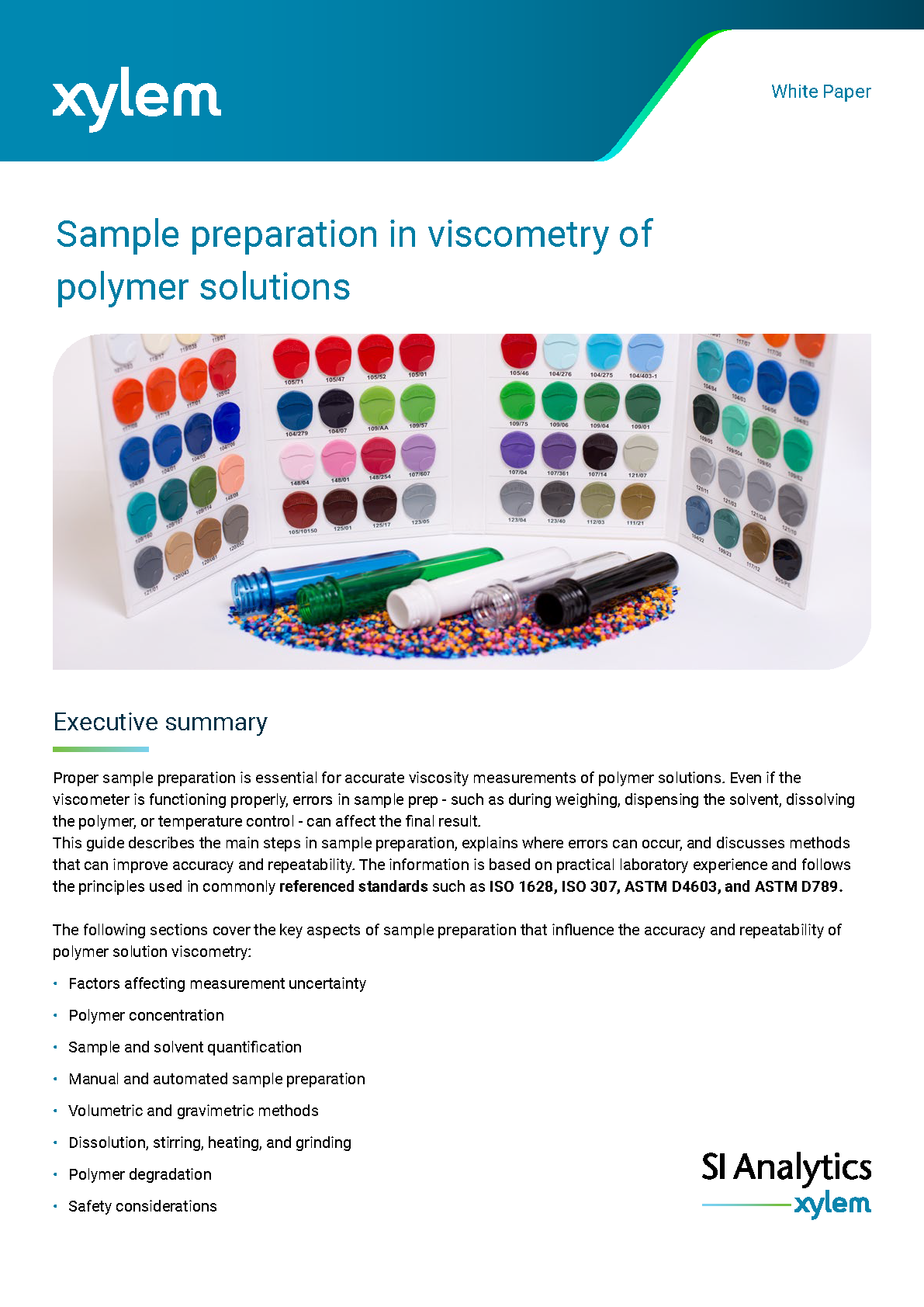 Download the full whitepaper now
If you'd like to learn how to optimize sample preparation in your lab and avoid common sources of error from the start, download the full white paper now.
Download whitepaper "Sample preparation in viscometry of polymer solutions"
In it, you will find detailed recommendations on concentration determination, solvent weighing, dissolution processes, and dealing with polymer degradation, as well as a comparison of manual and automated methods. All information is presented in a practical manner for use in analytical laboratories and quality control.
Sources
[1] SIA_Sample preparation in viscometry of polymer solutions_Whitepaper…, p.1
[2] SIA_Sample preparation in viscometry of polymer solutions_Whitepaper…, p.2
[3] SIA_Sample preparation in viscometry of polymer solutions_Whitepaper…, p.2
[4] SIA_Sample preparation in viscometry of polymer solutions_Whitepaper…, p.3
[5] SIA_Sample preparation in viscometry of polymer solutions_Whitepaper…, p.2
[6] SIA_Sample preparation in viscometry of polymer solutions_Whitepaper…, p.6