WATERWORLD
More AQA support for the photoLab® Series
AQA 3 – The Matrix Check
Non-plausible and incorrect measuring results are a phe-nomenon that can occur in samples depending on the sample composition/matrix. The cause of these is often interference presented by reaction-relevant sample con-tent substances: For example, they simulate a higher con-centration due to the similar load or ion size or they remove the measuring parameter by forming complexes and thus show smaller concentration values. Classic exam-ples from the sewer system are the interference of the ammonium determination by potassium or by nitrate measurement by chloride.
Following good laboratory practices (GLP), interferences are first detectable by the determination of a suitable standard solution, as the nominal value will not be found correctly. For the cause study search for interfering forces, the MatrixCheck is a suitable aid; it works with a so-called buildup or dilution of the sample. For this buildup, defined small volumes of a known concentration are added, some-times in the course of several steps. As the concentration is known, you can observe, whether and how it is reflected in the measuring result. The result can also be indicated as a so-called recovery rate of the added quantity. In most cases, a recovery of < 90% and >110% points to an interference.
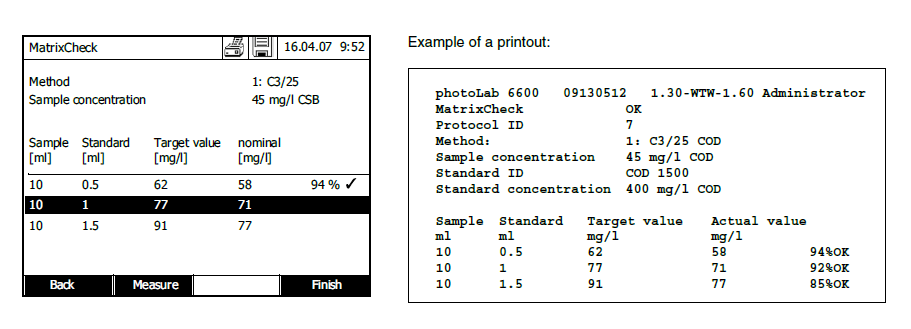
For a convenient and sample matrix check, photoLab® 6100 VIS and photoLab® 6600 UV-VIS offer the new func-tion AQA 3 - matrix check for the supplementation and dilution with recovery rate:
With the commercial multi-parameter standards Com-biCheck® for programmed test sets, the respective instruc-tion values are already given via the display and menu guide; for your own methods or when using individual standards, there is also the possibility of a step-by-step buildup (max. 3).
The results can be saved and put out as a result log for the documentation.
Observation:
The photoLab® 6600 UV-VIS and photoLab® 6100 VIS spectrophotometers have meanwhile been replaced by the successor models photoLab® 7600 UV-VIS and pho-toLab® 7100 VIS respectively. These models offer the same AQA 3 functionality.
Here you can download the whole article as a PDF: