Refractometers 101 & the need for quality control
With over 100 years’ experience, Bellingham + Stanley is well positioned to give good, practical advice to refractometer users all around the world. Our experts have pulled together 18 Top Tips for achieving quality results from your refractometer! Whether you’re looking for hints on buying the best refractometer for your application or wanting to learn about refractometer care and maintenance we’ll have something for you.
What is a refractometer and how does it work?
 A refractometer is a scientific instrument used to measure refractive index. As our parameter page states: “When light passes from one medium to another, the speed at which the light travels will change depending on the parameters of the materials. This principle can be seen when looking at a straw in a glass or an oarsman on the river, where the straw or oar appears to be bent at the water/air interface. The ratio or change in the speed of light is called refractive index and instruments that measure this are called refractometers.”
Refractive index is often converted into a concentration measurement, typically of sugar (displayed commonly as °Brix) for food applications or other easily useable concentration scales relative to the products being measured. Common scales include °Brix, Ethylene Glycol, Propylene Glycol, Fructose, Glucose, Starch, Water-in-Honey, Urea, Wort, and °Zeiss. For a full list of scales associated with Bellingham + Stanley’s OPTi digital handheld refractometer click here.
Refractometers come in several shapes and sizes and differ in accuracy and technological sophistication. From simple optical handheld instrumentation, to digital bench-top refractometers with flow-through accessories that can form part of complete purity packages.
Before we get started with our top tips for achieving quality results from your refractometer, we wanted to talk a little about quality control.
Refractometers for quality control
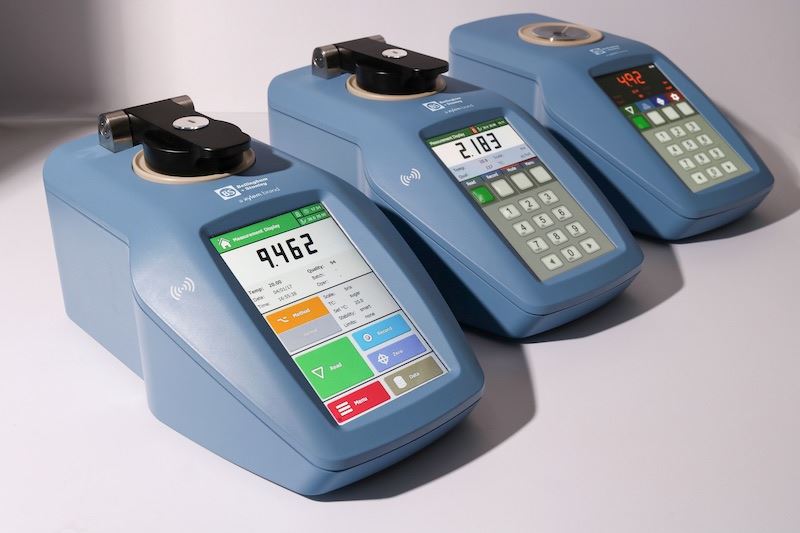 Refractometers are commonly used as a quality control tool within factories and laboratories. The importance of good quality control (often referred to as QC), whether in food, beverage, pharmaceutical or chemical manufacture, is to ensure all finished product is consistent and meets the required (and often regulated) specification.
Investing in a good quality refractometer from a reputable manufacturer, such as Bellingham + Stanley, is therefore essential to the quality of your end product – whether you’re making small batch craft beer, supplying a supermarket with jams and marmalades, or determining purity and concentration of pharmaceutical ingredients.
Good QC has an impact on profits too. Most people define QC as quality control, but it can also be interpreted as quantity control, where quantity relates to the dilution or blend of an expensive raw material such as concentrated apple pulp (for example) used to make juice. Over-dilute and you’re simply giving money away. Under dilute and you run the risk of breaching specification limits, creating unhappy customers who don’t come back for more, or even losing supply contracts.
Choosing a Refractometer
What is needed to ensure reliable results when taking refractometric measurements? Whether they be Brix, RI, Urea, or many of the other application specific scales that have evolved over the 150 years refractometers have been in use, we’ve got the answer.
Tip 1: Choose the right refractometer for the job
Choosing the right refractometer for your application can be tricky. There are many different models of refractometer to choose from, and prices can range from €30 right up to €10,000. How do you know which one is correct for you? A useful tip is to start by thinking about your measurement needs and the environment in which the reading is to be taken. This will help you determine the right instrument for the job in hand.
A simple, low-cost handheld refractometer is fine for field testing before fruit harvest or for checking chemical dilution in the automotive industry. For less mess and accurate results we recommend going digital with the OPTi Digital Handheld Refractometer from Bellingham + Stanley.
If you’re mixing expensive raw materials or controlling a high-speed bottling line in a beverage factory then a sophisticated instrument is required. Bench-top digital refractometers such as the RFM-Series from Bellingham + Stanley are ideal when there are needs for tighter control to avoid even the smallest amount of waste. Technologically advanced refractometers such as these are suitable for a factory environment.
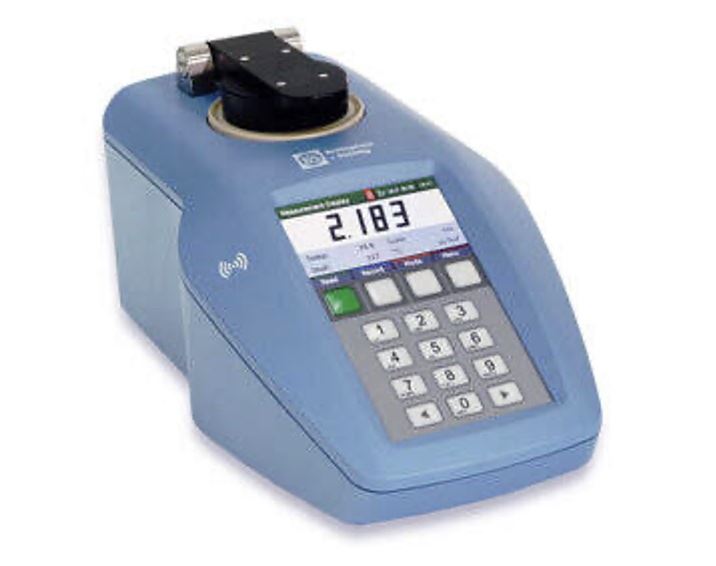
Refractometers such as the RFM900-T Series offer top of the line features, precision and accuracy and are suitable for both the laboratory and factory. These Peltier temperature-controlled digital refractometers include a wide measuring range and 7” touchscreen user interface. They are ideally suited for use in applications within the chemical, petrochemical, pharmaceutical, flavours and fragrance industries due to their wide refractive index range and Kalrez® prism seal as well as in academic research.
Tip 2: Understand the effects of temperature on Refractive Index
Did you know that refractive index changes significantly with variations in temperature? These variations are very important to consider if you want to achieve reliable measurements.
Within food and beverage, sugar-based foodstuffs including beverages, sauces, and confectionery are specified at 20°C and have very similar temperature characteristics, so can be treated together. Organics such as oils and aromas differ widely with temperature change and so must be considered independently.
For more information about how temperature affects refractometry download the Bellingham + Stanley Refractometry Handbook. Here you’ll find information on temperature control, measurement, compensation and more.
Tip 3: Talk to the experts
It might sound simple, but going to the source may answer any queries you have. Very often instrument manufacturers have a wealth of information collected over the years and they can be a great source of advice, so be sure to speak with them. Once you’ve chosen your refractometer, think about pre- and after-sales advice. Consider choosing a brand from a local supplier if possible, so that you can be supported throughout the lifespan of the product. Don’t settle for so-called “box shifters” or other “marketplace” style websites. Remember: the quality of your final product is at risk!
Tip 4: Think about who will be using the refractometer
There is no benefit in having the most sophisticated refractometer if you don’t stop to think about the people that are expected to use it. You wouldn’t hand over the keys to a Ferrari to someone without a driving licence! OK, perhaps that might sound a little extreme, but proper consideration must be given to what the instrument is to achieve vs. the skill set of the people expected to achieve it.
Whilst the measurement of Refractive Index is a simple process, not all instruments are built equally. It is worth looking around for a device that has an intuitive display, like the RFM refractometers from Bellingham + Stanley that include a colour coded menu structure and touchscreen to help guide users in their daily work.
Tip 5: Clear operating procedures and proper training
 No matter what industry you’re in, good operating procedures and proper training in the use of the instrumentation is essential if you are to get the best from your refractometer. Look for a digital refractometer with operating assistance through on-screen prompts. These can help guide the operator to take precise measurements with very little training.
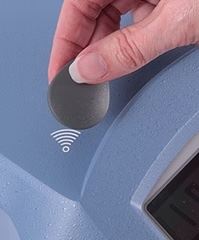
Password protection ensures operators can be separated by tiers of operation. This can help protect sensitive configuration menus against accidental manipulation so that instrument integrity is intact throughout the working day. Some refractometers even use RFID tags, allowing you to tap a secure tag to log in.
If available, use the instrument’s on-board audit trail that logs who has done what so that any unauthorised changes to the instrument’s configuration can be easily traced. This ability to log audit trails and separate users is especially key to those looking to abide by FDA regulation 21 CFR part 11. For more on these regulations and how Bellingham + Stanley can help you comply click here.
Tip 6: Sample preparation is the key to good measurement
Preparing a sample prior to measurement with a refractometer is important. For handheld refractometers, this could be as simple as degassing soda from canned drinks using cups. If you’re using fruit, simply crush it until it becomes a smooth juicy sample. Remember to remove any pips, seeds or fleshy pulp. For fibrous product like carrot, potato, turnip or swede, use a grater to break down the fibres and then squeeze the juice from a handful of the shreds before taking a measurement.
How do I remove the gas from a fizzy drink or soda?
Here’s a quick hack for removing gas from carbonated drinks: Simply take two cups and pour the fizzy drink back and forth between the two containers. This motion will very quickly degas the soda!
Sample preparation & taking a reading with a refractometer
Now let’s concentrate on taking measurements with a refractometer and take a closer look at how temperature can affect samples and readings.
Tip 7: Apply the right amount of sample to the refractometer prism
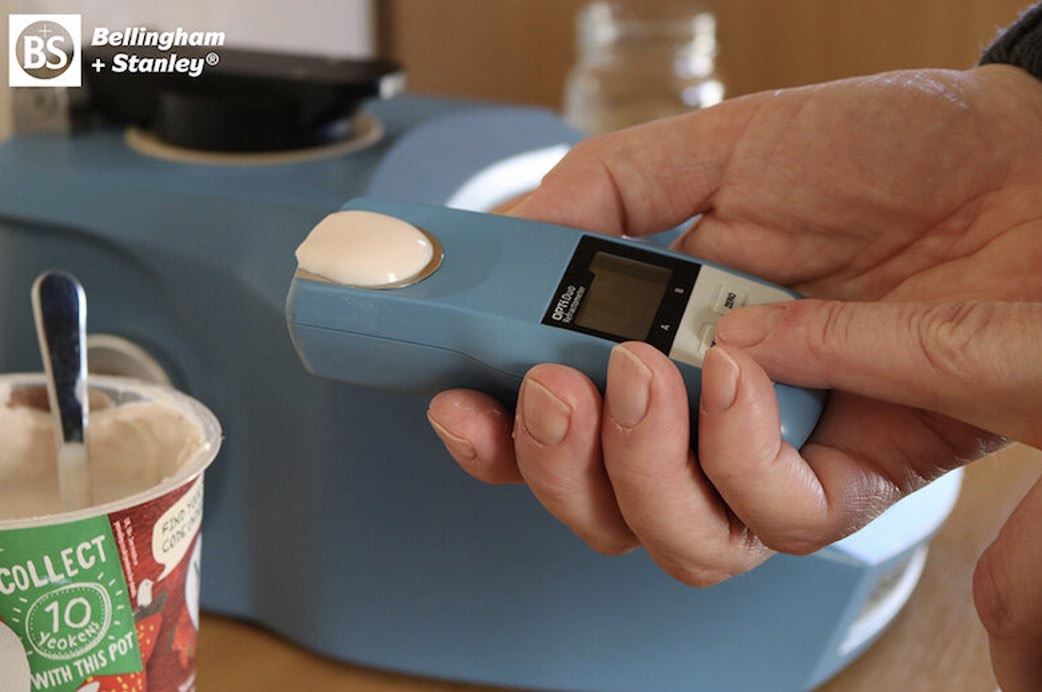 When taking a reading with a refractometer we tend to think of Goldilocks and the Three Bears – If you apply too much it will take longer to stabilise, like having too much water in a kettle or pot will cause it to take longer to boil. Likewise, if you apply too little the interface between the prism and sample will not refract properly. To ensure best performance always use the refractometer presser, plate or flap if fitted. Always make sure that you read the instrument’s manual for advice on sample size.
To recap, learn to apply “just the right amount” of sample. Too much it will take longer to stabilise, and too little will cause the sample to refract poorly. The sample should cover the working area of the prism surface. For digital refractometers, sample depth should be 2-3 mm to prevent light leaching back into the optical detector from the sample/air exit interface.
Tip 8: Watch out for highly concentrated layers or “skins”
When measuring sugar syrups with a refractometer always ensure that you take time to stir the syrup slowly and sufficiently before taking a sample. This is the best way to avoid highly concentrated (and unrepresentative) “skin” that can form on top. (Imagine serving the skin on top of a custard, rather than the creamy goodness underneath – it’s not what you want, or what you’d expect!)
Just as important is to make sure that you do not stir too vigorously though; you don't want to entrap micro air bubbles that may also interfere with the refracted ray!
Tip 9: Some (samples) like it hot!
To take a measurement of refractive index all refractometers need to “see through” a sample*. We know that light simply cannot pass through solid objects and the same applies here. To help the instrument pass light, heat up viscous, semi-solid and solid samples like waxes, fats, edible oils & butter before applying to the prism to take a reading with your refractometer.
When measuring hot samples next to the production line, you should reduce stabilisation times by increasing the instrument’s temperature to that of the sample. Then use temperature compensation to give the result as if it was at 20°C.*optical instruments working in transmission mode - for reflection mode (digital) see point below.
This technique especially applies to refractometers measuring the total solids of instant coffee prior to freeze drying so that sediment doesn’t form on the prism whilst waiting for equilibrium.
Tip 10: Manage the effects of temperature
Optical handheld refractometers offer limited temperature correction using a manual offset or bimetallic strip allowing you to compensate. Most users of handheld refractometers will find this adequate for the typical measurement offered from such an instrument. As an improvement to this, many digital handheld refractometers use a technique called sugar compensation. For other non-sugar samples, high grade digital handheld refractometers, such as the OPTi Digital Handheld Refractometer from Bellingham + Stanley, use application specific compensation to provide a far more accurate result.
For accuracy and convenience digital bench-top refractometers found in laboratories or factories use electronic/mathematical temperature compensation for sugar-based products but for ultimate performance, look for Peltier temperature controlled refractometers.
Peltier temperature-controlled refractometer systems control the prism and surrounding plate so that the sample is controlled to the desired measurement temperature. Ideal for those non-sugar organic and inorganic samples.
Tip 11: Wait for temperature stabilisation to avoid moving targets
Always give the sample enough time to stabilise to the ambient temperature of the refractometer. Failure to do so will cause your refractometer borderline to be moving! This is obviously unsuitable for accurate measurements. Patience will be required for a little bit of precision.
Modern laboratory instruments like the RFM340-T refractometer offer stability checks so that the reading will only be given after a set time, or better still, when the instrument detects both sample and temperature readings have stabilised – SMART!
Tip 12: Keep your refractometer prism clean
Remember to clean the prism and plate of your refractometer after each and every use! It is also important to dry it properly. Cross-contamination between samples and cleaning materials will create erroneous results the next time it is used.
Note: The cleaning process is critical when using reference materials to verify the instrument.
Tip 13: Sanity check
If the reading isn’t what you expected or, when using an optical handheld refractometer, the borderline doesn’t look as sharp as it normally does for that sample, start again!
For digital refractometers that feature a quality indicator, check to see if the number is correct for the sample being measured. Some “Methods based” refractometers, such as the RFM900-T from Bellingham + Stanley, with a limit checking function also allow you to set a threshold for each sample so that anything unusual is displayed to the user as an error message. Limit functions may also be applied to the temperature and quality value as well as the measured sample reading.
Continuously achieve accurate results through maintenance
Lastly, we’ll be looking at how you can continuously achieve accurate refractive index results through verification, calibration and general maintenance of your refractometer.
Tip 14: Treat handheld refractometers with care for continuously accurate results
Optical and digital handheld refractometers require little maintenance, often only requiring a zero calibration with water. For high range instruments that don’t have a zero point, use a sugar sample or for optical instruments, a solid test plate. Some digital handheld refractometers also allow verification of the upper scale using a long-life, certified sample. You can purchase solid test plates, sugar solutions and long-life certified samples from reputable refractometer specialist stockists such as Refractometer Shop.com.
Always keep your refractometer clean. Remove all traces of sample from the prism once it has been read (a clean tissue is fine for this) and keep your refractometer in a safe place; after all, a refractometer is a delicate, scientific instrument.
Tip 15: Consider installation and training as a start-up package
When purchasing your new refractometer consider installation and training as part of a new user start-up package. For regulated environments such as within the pharmaceutical industry, it is worth asking the instrument manufacturer, their local distributor or even an independent validation contractor to perform a validation (IQ/OQ/PQ) using traceable standards prior to use. Configuration and start-up training can then be done in one session saving time and money.
Tip 16: Verify refractometer performance regularly
Verify and, if necessary, calibrate the refractometer using a traceable certified material like an AG Fluid, calibration oil, or sucrose solution on a regular basis. Typically, a ZERO verification should be performed daily. SPAN, a validation of the upper part of the scale or in the range where you normally take measurements, should be done weekly and only after a ZERO validation.
If using a sucrose-based calibration solution, always squeeze some sample and reject to waste to ensure no crystals have formed in the nozzle. Only adjust the refractometer if it falls out of specification and make sure samples are left long enough for the temperature to stabilise (as mentioned above!)
Clean and dry the prism carefully between each verification and if there is any doubt about the reading shown, do it again to ensure you don’t calibrate in any erroneous readings! Always consult with the instrument instructions and the guidelines of the standard being used.
Tip 17: Schedule regular maintenance within your operating procedures
With busy work schedules it can be all too easy to forget or skip regular maintenance. Create and regiment a schedule within your operating procedures to ensure compliance. This may include routine cleaning, the changing of any consumables such as lamps, flow-through pipes or even air filters. Some refractometers allow you to create a schedule of calibration and maintenance due dates within the onboard calendar, so be sure to take advantage of these features if they are available.
Tip 18: Preventative maintenance contracts are a good idea
Most suppliers of digital bench-top scientific instrumentation including refractometers will offer contracted service plans or ad-hoc maintenance.
For peace of mind, and for continuously accurate results from your refractometer readings, it is wise to have your instrument checked out by the supplier or manufacturer on a yearly basis, especially if controlling critical or regulated products.
Remember, “prevention is better than cure.” It is better to keep a bad thing from happening than to fix the bad thing once it has happened. Preventative maintenance not only ensures reliable use and extends the life of the instrument, but it may also help to prevent a catastrophic breakdown. Remember: Your production’s quality control could rely on this instrument being up and running at all times. Extended downtime for the instrument could mean loss of working hours and profit!
If you’d like to learn more about Bellingham + Stanley refractometers visit our refractometer overview or if you’d like to speak to us about choosing the correct refractometer, maintenance, or to review service options contact the B+S customer care team today.
The refractometry guide with helpful hints and tips
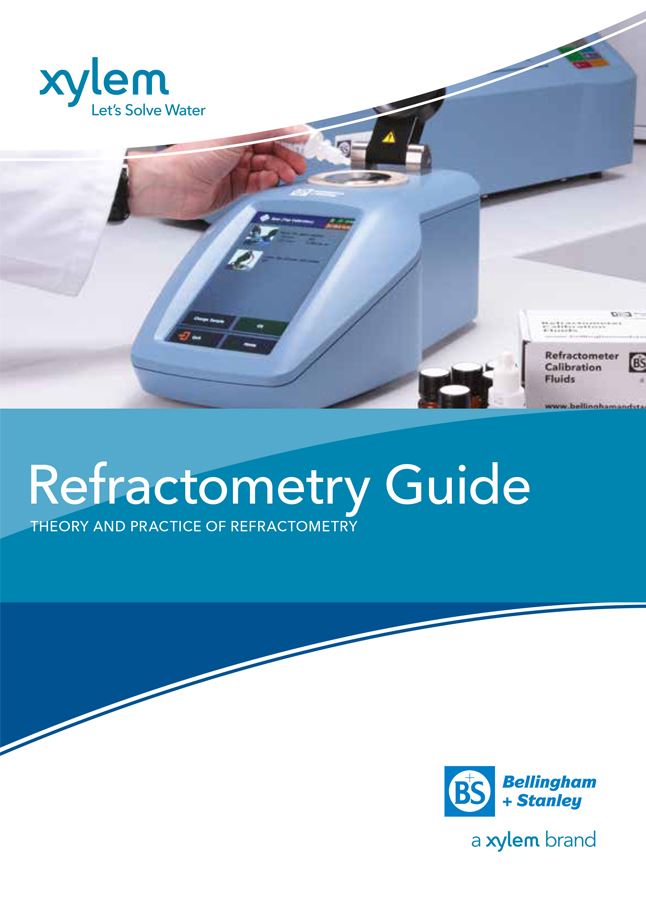 The refractometry handbook will teach you the basic principles of refractory and the instruments used to measure refractive index and °Brix. Originally written by pioneers of the handheld refractometer and revised over the years by experts in the field this handbook will guide you through different modes, the effects of temperature, sample prep and more.
Download now